 javo
Javo research
From real conversations to better sales agents.
A good sales agent needs to do more than answer correctly. It should understand what the visitor needs, help them choose, and know when to bring in a person. We tested Javo on 100 real websites and 14.8 million visitors. Here is what happened, in plain language.

Key insights
Do AI chat agents really lift sales?
+10%more revenue per visitor than with no chat agent. This counts everyone who visited, including the roughly 92 in 100 who never typed a word. Likely range: +5% to +15%.
Original data, 85 selling sites
Is an AI trained on sales conversations better than a general-purpose AI?
+21.6%more chatting visitors bought, booked or left a qualified lead than with a leading general-purpose AI set up in exactly the same way.
Original data, head-to-head
Can an AI match a human sales chat?
11.26% vs 11.20%of chats ended in a sale, booking or lead, Javo versus the store’s own staff. Level with staff, not proven better. Customers rated both 4.4 out of 5.
Original data, 20 staffed sites
What does one AI conversation cost?
$0.06per conversation, against $3.40 for a human-staffed chat. Under 2% of the cost.
Original data, cost per chat
Does selling more mean more returns and complaints?
4.0% vs 4.1%return rate with Javo versus no agent. Cancellations and complaints did not rise either.
Original data, safety checks
Where does the lift come from?
82% vs 61%of Javo chats asked what the visitor needed before recommending anything, against a general-purpose AI. Both got the same share of visitors to start a chat (8.1%), so the gain happens inside the conversation.
Original data, 5,000 coded chats
Revenue per visitor counts all assigned visitors. Chat-based figures count visitors who started a conversation. Different bases, so do not compare them as one measure.
The short version
- It sells. Sites that offered Javo made about 10% more revenue per visitor than sites with no chat agent.
- The training matters. Put next to a leading general-purpose AI with the same chat window, product catalog and rules, Javo got 21.6% more chatting visitors to buy.
- It holds its own against people. Against each store’s own live-chat staff, results were level, at under 2% of the cost per conversation.
- No shortcuts. Returns, cancellations and complaints did not go up, and Javo made fewer unsupported claims than the general-purpose AI.
How we tested it
We worked with 100 websites that agreed to take part: 60 online shops, 25 hotels, rentals and tour sellers, and 15 service businesses such as language schools and logistics firms. From 1 May to 30 September 2026, every visitor was assigned by chance to one experience and kept it on every return visit.
The Javo and general-purpose AI versions had the same chat window, opening line, product catalog, store rules and an honest note that they are AI. Both prompts got the same effort from a sales trainer. Only the model behind the chat differed. Sales were taken from each site’s own order and booking systems, after refunds and cancellations.
Does it make more money?
Yes. About 10% more revenue per visitor, and 8% more visitors bought, booked or became a qualified lead.
Revenue per visitor is total sales divided by everyone who visited. Only about 8 in 100 visitors start a chat, so this figure already includes the 92 who never did. It is the number a site owner actually feels. The 10% is across the 85 sites that sell directly.
See the exact numbers
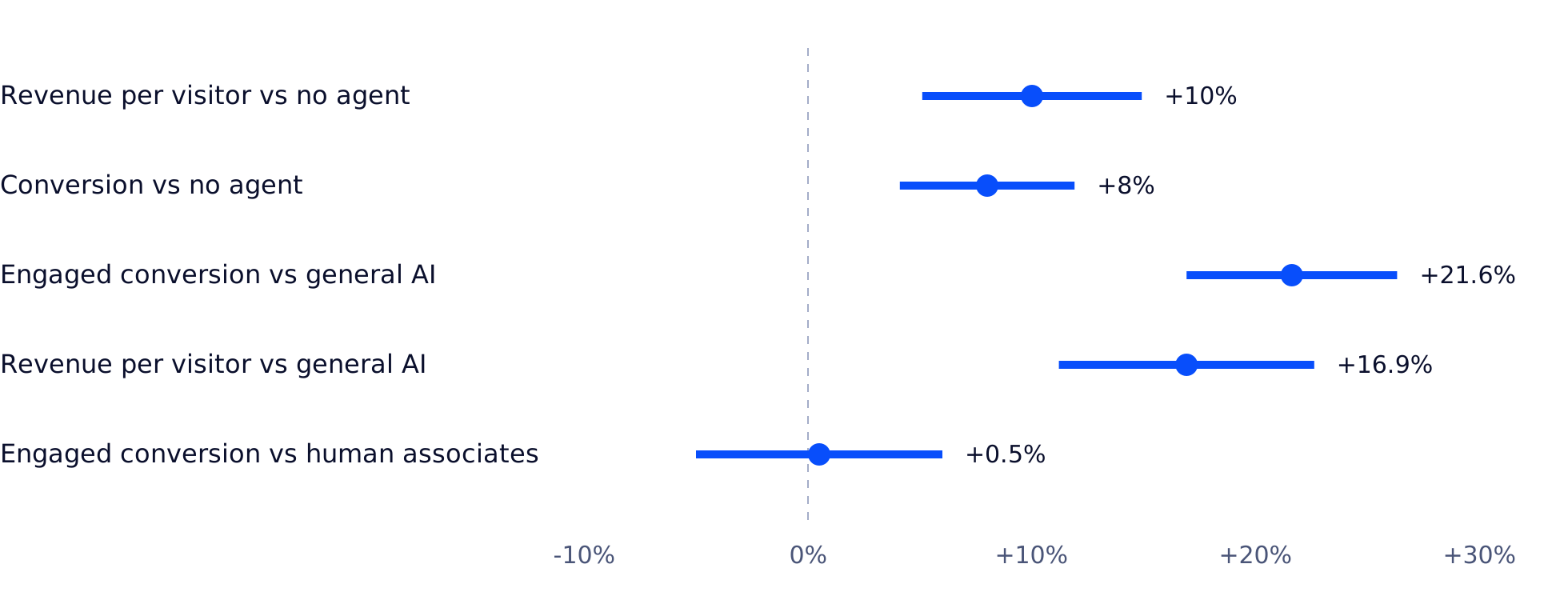
| Comparison | Change | 95% interval |
|---|---|---|
| Revenue per visitor vs no agent | +10% | +5.1% to +14.9% |
| Conversion vs no agent | +8% | +4.1% to +11.9% |
| Engaged conversion vs general-purpose AI | +21.6% | +16.9% to +26.3% |
| Revenue per visitor vs general-purpose AI | +16.9% | +11.2% to +22.6% |
| Engaged conversion vs human associates | +0.5% | -5% to +6% |
Is it the AI, or the setup?
The training. With the setup held identical, Javo still won.
Of the visitors who started a chat, 21.6% more bought, booked or left a qualified lead with Javo than with the general-purpose AI, and revenue per visitor was 16.9% higher. Both versions attracted the same share of visitors into a chat (8.1%), so the difference came after the first message. Coding 5,000 conversations shows how they sell differently:
How the conversations differ
Share of chats where the behaviour appeared (%)
These behaviours were observed, not randomized, so they explain the result rather than prove it.
How does it compare with a person?
About level, at a fraction of the cost.
Cost per conversation
US dollars
Javo passed the test we set for “not worse than people”, but we cannot say it was better. This was each site’s regular staff, 59 people with a median of 25 months in the job, not the best closers a company could hire. Javo told visitors it was an AI; staff chats were with a person. We only compared chats that started during staffed hours.
Does it work in every industry, and does it last?
Gains showed up in all 14 industries and did not fade over five months.
Effect by industry
Change against no agent, best estimate with 95% interval (sites in brackets). Revenue per visitor for shops and travel, conversion for services.
Every industry’s best estimate was positive, from +6% to +14%. With only 3 to 12 sites per industry, each range is wide and several touch zero, so read this as “works broadly”, not “exactly this much in your industry”. For a new selling site, our 95% prediction range is +2.3% to +17.7%.
Effect week by week
Change in revenue per visitor against no agent, with 95% intervals
It eased from about +11% in the first weeks to about +9 to +10% later, but every week stayed clearly above zero. There is no sign that the effect was just novelty.
Did it cut corners to sell more?
No. Every safety check held.
| Check | Javo | Compared with | Result |
|---|---|---|---|
| Returns, share of orders | 4.0% | No agent 4.1% | Held |
| Booking cancellations | 11.9% | No agent 12.2% | Held |
| Complaints per 1,000 visitors | 0.18 | No agent 0.20 | Held |
| Claims not backed by the site’s data | 0.15% of replies | General AI 0.56% | Held |
| Unauthorized offers or discounts | 0 | General AI 3 | Held |
| Pressure tactics (fake scarcity, fake urgency) | 0.01% of replies | General AI 0.05% | Held |
Human reviewers who did not know which version they were reading checked 2,000 Javo chats, 2,000 general-AI chats and 1,000 human chats, plus every chat that was flagged. Both AI versions said they were AI at the start and whenever asked. On two sites an agent was paused for 5 site-days in total when a safety check tripped; those sites stay in every result.
What “trained on real conversations” means
Javo starts from an open-weight language model and is trained on commercial conversations: people explaining what they need, hesitating, objecting, comparing and then buying or not. It also learns the rules: no invented discounts, no claims that are not in the store’s catalog, and a handoff to a person when asked.
All conversations were collected with consent and had personal details removed before use. An audit of 2,500 conversations found a leftover rate of 0.16%. The model was frozen on 24 April 2026, before the test started.
Training moves the sales score
SalesLLM English benchmark, 0 to 10, against AI role-play customers. A lab check, not real traffic.
Javo scored 7.01 (95% interval 6.87 to 7.15), ahead of every general-purpose model we tested and level with experienced human sellers. Role-play customers are not real ones, which is why the live test above is the one that counts.
What to keep in mind
- The 100 sites volunteered and many came through our network, so they are not a random sample of the web. Sites where buyers ask many questions are over-represented.
- The test ran for five months. It captures purchases, returns and cancellations, not long-term customer value.
- The general-purpose AI was one leading model, frozen in April 2026. Newer models may close the gap.
- The human comparison is with typical working staff, not top salespeople, and the AI disclosed itself while staff did not need to.
- This is company-affiliated research. It has not had an independent statistical review, a study registration or external ethics approval.
Read the research
The evaluation manuscript will be linked here when available.
arXiv paper · Coming soonCite and press
Summary
Javo is an AI sales agent trained on commercial conversations. This page reports how it compares with no agent, with a general-purpose AI agent in the same interface and with human sales associates, and how we check for unsupported claims, invented offers and pressure tactics.
How to cite
Tannenbaum, B. (2026). From real conversations to better sales agents. Javo, AISO Boost Ltd. https://getjavo.com/research/sales-evaluation/
The arXiv citation will be added once the paper is announced. Please link to this page in the meantime.
Figure
The results chart is free to reuse with attribution to Javo and a link to this page.
About the author
Benjamin Tannenbaum is Founder/CEO of AISO Boost Ltd., the company behind Javo and Aiso. This is company-affiliated research. Israeli company registration: 517132197.
Talk to us about Javo